
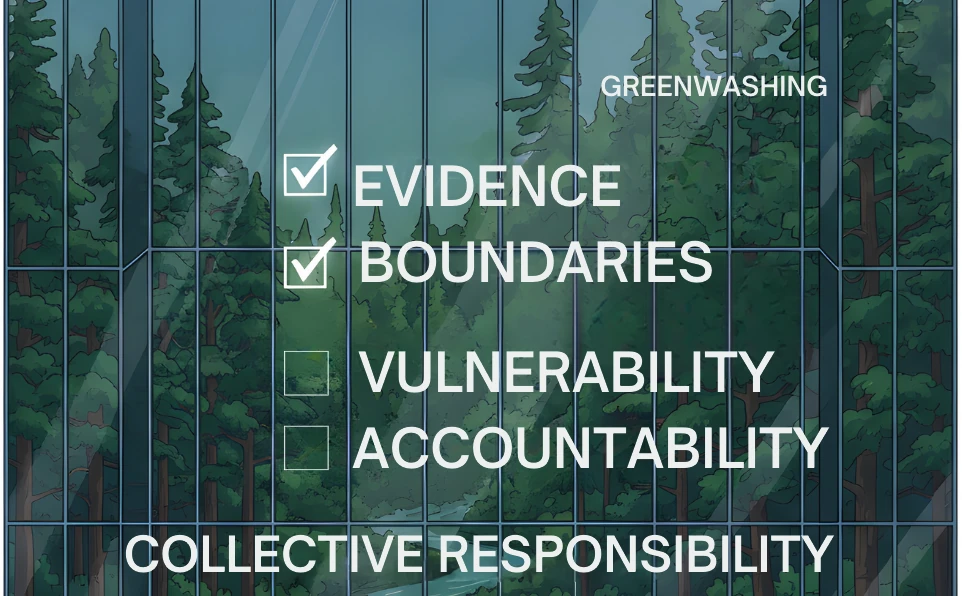
Greenwashing • AI Ethics • Responsible Communication
Greenwashing: How “Nature Will Bounce Back” Becomes a Moral Alibi
When Nature Becomes Our Best Moral Alibi
Published on Prompt & Pulse • 23 February 2026 • Article co-written by a human and an AI • Estimated reading time: 14 minutes • Last updated: 23 February 2026
Key takeaways
- “Nature will bounce back” is a comfort sentence, not a response to specific harm. It manages how we feel — without changing what we do.
- Greenwashing does not require lying. A true sentence can still create a misleading impression — if it hides what matters most.
- Rights of nature become real only when linked to named obligations, independent verification, and concrete consequences.
- AI makes greenwashing cheaper to write — and cheaper to detect. Both sides of that equation are now available to SMEs.
- In the EU, rules on environmental claims apply in full from 27 September 2026 (Directive 2024/825). Vague language is becoming a legal risk, not just an ethical one.
1. Greenwashing Starts Here: “Nature Will Bounce Back” and Why It Shuts Down the Conversation
“Nature will bounce back.” You hear it in board meetings, in climate keynotes, and in the quiet voice of someone who wants to sleep at night. It is one of the most common forms of greenwashing — not because it is false, but because it replaces a concrete response with a comfortable feeling. The sentence is not always cynical. Often, it is simply a way of closing a difficult conversation before it becomes uncomfortable.
At geological scale, the statement is technically accurate. Life reorganizes. Ecosystems rebuild over centuries. The biosphere has survived mass extinctions before. But zoom in to a human timescale and the picture changes entirely.
Climate damage does not fall on “humanity in general.” It falls on specific people, in specific places — a community living downstream from a mine, a farmer whose growing season is getting shorter, a coastal town that still has a few years to prepare before flooding becomes too frequent to manage. Moreover, the people and ecosystems hit first and hardest are also the ones with the least capacity to recover.
A reassuring sentence is not a response to any of that. It manages how we feel about the problem. It does not address the problem itself.
Resource extraction has already tripled over the last five decades, and without significant structural change, it could rise sharply again by 2060.1 When we tell ourselves that nature will recover, we feel better. And once we feel better, we are less likely to act.
2. What ethics actually means, across cultures and contexts
Before going further, a few definitions.
How ethical standards are applied is not the same everywhere. What counts as fair, harmful, or responsible varies across cultures and changes over time. This matters for environmental claims. But it does not mean anything goes. It means that when a company says “we protect the living,” the real question is not only whether the statement is true. It is also: true by whose standards, measured by which methods, and for which communities.
Ethics is not a feeling. It is a discipline. And disciplines require definitions, measurements, and accountability — not just good intentions.
→ Related: AI Confirmation Bias — Question rewrites for ethical prompting
When your question hints at the answer you want, AI usually gives it to you. The frame shapes the answer. This article shows you how to spot the most common traps and gives you practical rewrites you can use today.
promptandpulse.fr/biais-de-confirmation-ia/3. Why we cooperate with greenwashing — even when we know better
Here is the part that is harder to admit. Greenwashing does not survive only because companies produce comforting claims. It survives because we help those claims circulate. We do it through habit, convenience, and small rewards.
A “responsible” label lets us buy, vote, invest, or approve a project while still feeling like we are doing the right thing. It is a quiet contract. They offer moral comfort. We offer our consent, our attention, and our silence. The result is a system where language reduces guilt faster than actions reduce harm.
This is not stupidity. It is a way of managing discomfort in a world where the real choices feel too hard. We need minerals, energy, logistics, buildings, devices, and medical infrastructure. We know our choices have a real cost. But that cost is uncomfortable to think about. So we trust the label instead.
Three specific comforts keep the system running:
- The comfort of innocence: “I chose the responsible option, so I did my part.”
- The comfort of continuity: “I can keep my current lifestyle and still feel like I am making the right choices.”
- The comfort of belonging: “Everyone around me is doing the same, so I am not the problem.”
These feelings are understandable. But when millions of people share them, harm continues — and gets called responsibility.
What Is Greenwashing? A Clear Definition
Greenwashing definition: Greenwashing is the practice of creating a misleading impression of environmental responsibility through vague, unverified or incomplete claims.
It does not require lying. A company can make technically true statements and still mislead — if those statements hide what matters most.
The term was coined in the 1980s and has grown in relevance as environmental claims have multiplied across advertising, annual reports, and product packaging. Today, greenwashing is not only an ethical concern — it is a legal one. Under EU Directive 2024/825, vague environmental claims will require substantiated evidence from September 2026.
Five signs a claim may be greenwashing
- No measurement. The claim uses positive language — "sustainable," "responsible," "green" — without any numbers, targets, or verified data.
- No boundary. The claim does not specify which products, sites, operations, or time periods it covers.
- No verification. There is no independent third party checking whether the commitment is being met.
- No consequence. Nothing happens if the commitment is not fulfilled.
- No mention of what remains harmful. The claim focuses entirely on what is improving, while omitting what stays unchanged.
→ Related: AI Confirmation Bias — Question rewrites for ethical AI governance
When your question hints at the answer you want, AI usually gives it to you. The same bias that drives greenwashing drives biased AI outputs. This article shows you how to spot the traps and rewrite your prompts for accuracy.
promptandpulse.fr/ethique-biais/blog-ai-confirmation-bias-ethical-prompting/4. How greenwashing works — and why we fall for it
Many companies accused of greenwashing respond the same way: “We did not lie.” And technically, they may be right. But greenwashing does not require lying. A true sentence can still create a false impression — if it hides what matters most.
So why does greenwashing work so well? Because it fits the way our minds naturally operate.
We tend to accept information that confirms what we already want to believe. If we want to think a brand is responsible, we will read its claims generously — and ignore the gaps.
We also feel uncomfortable when our actions do not match our values. A reassuring claim reduces that discomfort. It tells us everything is fine. And we want to believe that.
Finally, we are more comfortable with small improvements than with fundamental change. “A bit better” feels achievable. “Completely different” feels threatening.
Greenwashing — consciously or not — is built to take advantage of all three of these tendencies at once. Here is how it works, step by step:
Greenwashing takes a real and uncomfortable conflict — between what we consume and what that costs — and replaces it with a feeling: I am one of the good ones. Once that feeling is there, we stop asking questions.
→ Related: AI Confirmation Bias — Question rewrites for ethical AI governance
Many SME leaders use AI to support daily decisions. Small changes in wording can impact results even before the model builds a sentence. This guide helps you spot the most common bias traps and gives you practical rewrites you can use today.
promptandpulse.fr/ethique-biais/blog-ai-confirmation-bias-ethical-prompting/5. “Enabling mineral sustainability”: a case study in how language replaces accountability
In the mining sector, company communications tend to revolve around the same ideas: “responsible extraction,” “positive impact for communities,” and “innovation toward sustainability.” This is not specific to one company. It is a pattern that repeats across the entire industry.
The tension it exploits is real. Mining is directly linked to heavy industrial emissions.5 At the same time, the energy transition — solar panels, electric batteries, wind turbines — requires more metals and minerals, not fewer. Without significant change, global extraction could increase sharply by 2060.1
This is what makes the narrative hard to challenge. It is not a lie. The transition does need minerals. Safer operations are genuinely better. Innovation can genuinely help. But a message can be built entirely from true statements and still leave out what matters most — who bears the harm, how much harm there is, and whether any of it is actually being reduced.
Three techniques create this effect
Rename extraction as “enabling.” The company is not digging up the earth. It is enabling the clean energy transition. This framing feels like shared responsibility. It also makes it harder to ask who specifically is responsible for the damage.
Blend safety, efficiency, and environmental care into one message. Safer operations are good. More efficient operations can be good. But neither is the same as causing less harm overall. When the three are presented together, the positive elements make the whole package look better than it is.
Claim “positive impact” without saying what it covers. Positive compared to what? Measured how? For which communities? Verified by whom? When these questions have no answers, the reader fills the gap with hope.6
| Claim | Required proof | Named boundary | Known limit |
|---|---|---|---|
| “We protect the environment” | Measured reduction in named impact (kg, ha, m³) | Which site, year, species | What harm remains outside the claim |
| “Enabling mineral sustainability” | Absolute harm reduced vs baseline — not just per tonne | Which communities, which operations | What extraction continues unchanged |
| “Nature-positive operations” | Net biodiversity gain by independent audit | Which ecosystem, which timeline | Where measurement ends |
| “Aligned with climate goals” | Emissions trajectory vs Paris pathways | Scope 1–2–3, which year | What is deferred or excluded |
So when you read “Enabling mineral sustainability,” the question is not whether the company is acting in bad faith. The question is simpler: which harm is reduced, by how much, and who checked?
Real Examples of Greenwashing in Business
Greenwashing takes many forms. Some involve outright false claims. Most involve true statements carefully constructed to create a false overall impression. Here are four documented patterns, with real business contexts.
| Sector | Typical claim | What is missing | Lesson |
|---|---|---|---|
| Extractive industry | "We enable sustainable mining" | Absolute harm figures, community impact data, independent audit | Renaming an activity does not reduce its impact |
| Fashion | "Made with eco-friendly materials" | Percentage of materials, supply chain emissions, end-of-life impact | Partial improvement presented as full responsibility |
| Finance | "Our fund is ESG-aligned" | Which ESG criteria, which exclusions, which verification standard | Self-certification without third-party audit is not alignment |
| Technology | "Our AI is carbon neutral" | Scope 3 emissions, water consumption, energy source of data centres | Offsetting is not the same as reducing |
In each case, the claim is not necessarily false. But it creates an impression — of full responsibility, verified progress, measurable improvement — that the underlying evidence does not support. That gap between impression and reality is what greenwashing exploits.
6. Nature and law: protection in practice, or merely on paper?
A law that says “protect” is only as strong as what comes after it. Who is responsible for protecting? Against what specific harm? And what happens if they fail? Without answers to those three questions, the word “protect” does not protect anything.
Law is not just a set of rules. It is a way of shaping reality through words. When a legal text says “protect nature,” it needs to define what counts as harm, who has the right to complain, and what evidence is required. That is significant power — and it only works if the obligations are real.
Some countries have gone further than others. Ecuador’s constitution gives nature the right to exist and to be restored — written directly into the country’s highest law.7 In New Zealand, the Whanganui River has been granted the same legal standing as a person — meaning it can be represented in court, with defined rights and responsibilities attached to it.8 These are genuine attempts to protect living systems through law.
But writing protection into law does not automatically produce protection in practice. A company or a government can use the language of protecting nature without accepting any real obligation to do so. The words sound protective. The harm continues.
A simple test: six questions for any claim about protecting nature
- What exactly is being protected? Name the river, forest, species, or community.
- Protected from what? Name the specific harm — pollution, water depletion, habitat loss, community displacement.
- What is the concrete obligation? Name the rule or commitment that actually changes behaviour.
- Who checks compliance? Name the independent actor responsible for verification.
- What happens if it fails? Name the consequence — a fine, a suspension, a mandatory cleanup.
- Who benefits first? Identify the communities — human and non-human — who face the highest risk today.
If a claim about protecting nature cannot answer these six questions in plain language, it is not protection. It is a good story.
7. AI can produce greenwashing. It can also detect it.
AI makes greenwashing cheaper to write. But it also makes greenwashing cheaper to detect. That is the full picture.
On one side, AI has changed what it costs to produce environmental claims. One person with a well-designed prompt can now generate in an afternoon the kind of statements that once required a whole communications team. Claims that took days to write can now be produced, varied, and published in hours. Reassuring language has never been this easy to manufacture.
On the other side, AI can make verification easier too. It can compare claims across multiple documents, flag vague language, and detect contradictions between what a company says and what its operational data shows. The same technology that speeds up the production of comfortable language can also be used to expose it.
In practice, specific and verifiable claims hold up better over time. Vague claims are easier to challenge — and increasingly, easier to penalise. Building your communication on language that cannot be verified is becoming a legal risk, not just a reputational one.
There is one more thing to acknowledge. AI itself has an environmental cost — and that cost can be hidden in exactly the same way as any other inconvenient fact. The International Energy Agency projects that electricity consumption from data centres could roughly double by 2030, with AI as a primary driver.9 Water consumption for cooling adds a separate cost that rarely appears in company reports.10
Using AI to produce responsible-looking content does not make a company more responsible. If the energy powering those AI systems is never counted, it is still part of the environmental cost. It is simply not mentioned.
The honest approach is straightforward. Treat AI like any other resource your business uses. How much do you use? Where are the servers located? What energy powers them? In the EU, the AI Act is making these questions a legal requirement — not just a matter of good practice.11
→ Related: Medical Prompts — Responsible AI between precision and fair access
The same accountability logic applies wherever AI shapes decisions. When AI is used to produce sustainability claims, the same questions apply: what is being measured, by whom, and what happens if it is wrong.
promptandpulse.fr/ethique-biais/medical-prompts-between-diagnostic-precision-and-fair-access/8. Using AI responsibly: a practical guide for your environmental claims
The way you instruct an AI system shapes what it produces. A prompt that pushes for strong claims will generate strong claims — whether the evidence supports them or not. That means the person writing the prompt carries responsibility for the output, including its accuracy and its potential to mislead. At Prompt & Pulse, we encourage our clients to build ethical considerations into their prompts from the start — not as an afterthought, but as part of the process.
This is the logic behind our Evaluation before implementation service. Before a claim reaches your audience, your regulators, or your partners, it needs to hold up to scrutiny. We help you check that it does.
Four questions to ask before any environmental claim goes public
- “Does this claim include at least one measurable statement? What exactly are we committing to, and how will it be verified?”
- “In what ways could a reader interpret this claim as stronger than the evidence supports? What would we need to change to reduce that risk?”
- “Are we describing intentions or results? Where we use words like ‘protect’ or ‘support,’ can we replace them with something more specific — ‘reduce,’ ‘avoid,’ ‘measure,’ or ‘verify’?”
- “If AI was used to produce this claim, have we disclosed that? And have we accounted for the environmental cost of the AI systems we used?”
Seven steps before publishing any environmental claim
- State your claim in one sentence.
- Attach a concrete proof point — a number, a published plan, or an independent audit.
- Define what the claim covers — which sites, which communities, which time period.
- Name the groups most affected — both human and non-human.
- Remove any word that sounds protective but creates no real obligation.
- Ask how a sceptical reader would interpret this claim. Then rewrite accordingly.
- Record the date of publication and update the claim when the evidence changes.
→ Related: Medical Prompts — Sustainability compliance and responsible AI in practice
How prompts are used in clinical contexts, and why precision and fairness are inseparable. The same accountability logic — proof, boundary, consequence — applies across every sector where AI shapes decisions.
promptandpulse.fr/ethique-biais/medical-prompts-between-diagnostic-precision-and-fair-access/9. FAQ: Your questions answered
- Does nature have rights — or do we decide what rights it gets?
- In practice, nature has the rights we choose to write into law — and actually enforce. Some countries have gone further than others. Ecuador and New Zealand are two examples. But in most places, these rights exist on paper more than in practice. The real question is simple: do those rights come with clear obligations, someone responsible for checking, and real consequences if they are violated?
- What is the simplest definition of ethics I can use at work?
- Ethics is the discipline concerned with what is right and wrong. At work, it is not a feeling. It is a practice with methods, tests, and consequences.
- Does ethics change depending on culture?
- What people consider fair, harmful, or responsible does vary across cultures and over time. But that does not mean anything goes. It means that when you make a claim, the evidence behind it needs to make sense to the communities it affects — not just to you.
- What is greenwashing in one sentence?
- Greenwashing is creating a false or misleading impression of environmental responsibility — often through vague or incomplete claims. It does not require lying. A true sentence can still mislead if it hides what matters most.
- Why do we fall for greenwashing even when we suspect it?
- Because it is built to work with the way our minds naturally operate. We tend to accept information that confirms what we already want to believe. We feel uncomfortable when our actions do not match our values — and a reassuring claim reduces that discomfort. And we are more comfortable with small improvements than with fundamental change. Greenwashing takes advantage of all three tendencies at once.
- What does real legal protection for nature actually require?
- It requires three things: a named obligation that changes real behaviour, an independent person or body responsible for checking compliance, and a real consequence if the obligation is not met. A claim about protecting nature that cannot answer those three questions is not protection. It is a good story.
- How do I spot language that sounds protective but creates no real obligation?
- Ask one question: does this claim create a duty, or only an impression? If a company says it “protects living ecosystems” but cannot name what it is protecting, from what harm, verified by whom, and with what consequence if it fails — the language is doing the work that action should be doing.
- Is “Enabling mineral sustainability” always greenwashing?
- Not automatically. It becomes greenwashing when the claim has no defined scope, when intentions replace measurable results, and when the communities most affected — human and non-human — are mentioned in words but not protected in practice.
- Does AI have an environmental cost that SMEs should care about?
- Yes. And the more you use it, the higher that cost. Electricity consumption from data centres is projected to roughly double by 2030, with AI as a primary driver. Water used for cooling adds a separate cost that rarely appears in company reports. If your business makes sustainability claims, your AI usage is part of the picture — and worth tracking.
- What changes with EU Directive 2024/825?
- From 27 September 2026, environmental claims targeting EU consumers will need to be backed by evidence. Vague phrases like “eco-friendly” or “nature-positive” will no longer be enough. This is not just a reputational risk — it is a legal one. The directive was adopted on 28 February 2024 and member states have until 27 March 2026 to incorporate it into national law.
How to Avoid Greenwashing Under EU Law
From 27 September 2026, EU Directive 2024/825 changes the legal standard for environmental claims. Vague or unsubstantiated language is no longer just a reputational risk — it is a compliance liability. Here is what sustainability compliance requires in practice.
What the directive requires
- Evidence before publication. Any environmental claim must be substantiated before it is made public — not after a complaint is filed.
- Specificity. Claims must refer to verified, measurable improvements — not general commitments or aspirational language.
- No misleading omissions. Leaving out significant negative impacts while highlighting minor improvements is treated as a misleading practice.
- No generic environmental labels without EU-recognised certification or official verification scheme.
A structured recap: what greenwashing-proof language looks like
| Greenwashing language | Compliant alternative |
|---|---|
| "We are committed to the environment" | "We reduced Scope 1 emissions by 18% in 2024 vs 2022 baseline, verified by [auditor]" |
| "Eco-friendly packaging" | "Packaging made from 80% recycled material; 20% not yet recyclable in standard collection" |
| "Nature-positive operations" | "Net biodiversity gain of X hectares at [site], independently audited in [year]" |
| "Carbon neutral by 2030" | "Scope 1+2 emissions reduced by 40% by 2030 vs 2020; Scope 3 roadmap published [link]" |
The practical test is simple: if your claim cannot survive the six questions from Section 6 — what is protected, from what, by whom, verified how, with what consequence, for which communities — it is not ready to publish.
→ Related: Medical Prompts — Responsible AI between precision and fair access
The same accountability logic — proof, boundary, consequence — applies wherever AI shapes decisions. This article explores how responsible AI and sustainability compliance intersect in high-stakes contexts.
promptandpulse.fr/ethique-biais/medical-prompts-between-diagnostic-precision-and-fair-access/Conclusion: Greenwashing Ends Where Obligations Begin
The living world does not need better words. It needs fewer harms. And let us be clear about why this matters: protecting nature is not about saving the planet. The planet will survive. It is about preserving the conditions that make human life possible. What needs our attention is the gap between what we say about our environmental commitments and what we actually do about them.
Greenwashing does not survive because companies impose it. It survives because consumers, investors, and decision-makers all find it more comfortable to accept than to question. As long as that remains true, the language will continue to do the work that action should be doing.
If your sustainability language is mostly there to reassure — your clients, your partners, your own conscience — it will slowly become greenwashing. Not necessarily through bad faith. Simply through the very human preference for comfort over difficulty.
If your language is built to protect people and ecosystems — with clear commitments, measurable results, and honest limits — it will feel less polished. But it will also be harder to challenge, easier to improve, and more likely to produce the change you claim to want.
Pick one sentence on your website or in your next report that sounds responsible. Then make it testable. Define what it covers. Define what it excludes. Name who verifies it. And state what happens if it fails. If you cannot do that, you do not have a claim. You have a moral alibi.
5 things to remember about greenwashing
- Greenwashing does not require lying. A true sentence can mislead if it hides what matters most.
- The people most harmed by environmental damage are rarely the ones protected by environmental claims.
- Language that cannot be verified is not a sustainability commitment — it is a communications strategy.
- From September 2026, EU law treats vague environmental claims as a legal risk, not just a reputational one.
- The antidote to greenwashing is not better storytelling. It is named obligations, independent verification, and real consequences.
The difference matters — not just for legal compliance, and not just for your reputation. It matters for the people and ecosystems that your language is supposed to protect.
Ready to make your AI integration auditable before it goes live?
Request an Evaluation before implementation — Independent, fact-based assessment conducted before a tool is selected or a contract is signed. You receive a documented report stating what is already in place, what is missing, and the conditions required to integrate AI responsibly. The decision stays yours.
Verification process: All regulatory references are checked against primary sources (European Commission, IPCC, IEA, OECD). Claims about standards are reviewed before publication and updated when the regulatory landscape changes.
Last updated: 23 February 2026 | Changelog: Regulatory update — Directive 2024/825 (September 2026 enforcement); Green Claims Directive status clarified. Vocabulary and sentence structure simplified throughout. Conclusion updated.
Note: Article co-written by a human and an AI
This piece was drafted with assistance from a generative AI model for research, structure, and clarity. The final editorial choices, factual validation, and responsibility remain human. AI usage costs are tracked and disclosed in accordance with the editorial checklist in Section 8.
Read next
Sources and references
- 1 UNEP. Global Resources Outlook 2024. United Nations Environment Programme, 2024.
- 2 IPCC. Sixth Assessment Report — Synthesis Report. Intergovernmental Panel on Climate Change, 2023.
- 3 PMC. Ethics and Morality. PubMed Central, 2023.
- 4 Markkula Center for Applied Ethics. Ethical Relativism. Santa Clara University.
- 5 IPCC AR6 WGIII, Chapter 11 — Industry. 2022.
- 6 ScienceDirect. The Elephant in the Mine. The Extractive Industries and Society, 2024.
- 7 Ecuador Constitution, Article 71. Georgetown Political Database of the Americas.
- 8 Te Awa Tupua (Whanganui River Claims Settlement) Act 2017. New Zealand Legislation.
- 9 IEA. Energy and AI. International Energy Agency, 2024.
- 10 OECD AI. The Hidden Cost of AI: Energy and Water Footprint.
- 11 EU AI Act, Regulation (EU) 2024/1689. EUR-Lex, 2024.
- Encyclopædia Britannica. Ethics (philosophy).
- Markkula Center for Applied Ethics. What is Ethics? Santa Clara University.
- European Commission. Green Claims & Directive 2024/825. European Commission, 2024.
- European Parliament. Stopping Greenwashing: How the EU Regulates Green Claims. 2024.
- OECD. Protecting and Empowering Consumers in the Green Transition. 2025.
- European Commission. EU Artificial Intelligence Act. digital-strategy.ec.europa.eu.