AI Agent Governance: Why Cultural Blind Spots Create Risk
Published on July 7, 2026 · Reading time: 13 minutes
In one sentence: AI agent governance is not only about permissions, tools and technical controls. It also has to address cultural blind spots, because agents can misread human context and turn that misunderstanding into action.
Key takeaways
- AI agents do more than answer. They can draft, rank, escalate, route, update or trigger the next step in a workflow.
- Cultural blind spots are often quiet. They appear as small shifts in tone, priority or interpretation before anyone names the pattern.
- Fluent output is not proof of cultural accuracy. An agent can write well and still miss the relationship, hierarchy or local context behind the words.
- Governance must include human context. Before an agent acts, teams need to define who reviews, when escalation is required and what assumptions are being automated.
What problem do cultural blind spots create in AI agents?
There is a comfortable belief circulating around AI agents: if something goes wrong, it must be a prompting problem.
Rewrite the instruction. Add more context. Tighten the guardrails. Ask for a more precise tone. In many cases, that helps. Prompt quality matters. But it also hides a harder truth: an AI agent does not only fail because of a badly written instruction. It can fail because the organization assumes that culture, context and common sense are universal, when they are not.
This matters because AI agents are not just chat windows. They plan tasks, call tools, read documents, prepare messages, compare options, update systems and sometimes act across several workflows. Here is the practical difference: with a chatbot, a misunderstanding usually stays inside the answer. With an agent, the same misunderstanding can shape the next step: the message it prepares, the request it escalates, the candidate it ranks, or the task it triggers.
That is the shift. This is not only "AI bias" in the abstract. It is operational exposure: a client message that lands badly, a recruitment filter that misses a non-linear career, a training recommendation built on one cultural norm, a support workflow that reads indirect language as low urgency.
For a professional beginning with AI, the question changes. It is no longer only: "Is my prompt clear?" It becomes: "Whose context is missing when this agent acts?"
That question is easy to underestimate because cultural blind spots often look minor at first. A phrase feels a little too direct. A support reply feels colder than intended. A recommendation sounds efficient, but somehow detached from the person receiving it. None of these moments looks like a technical incident. Yet when they happen repeatedly, at scale, inside a workflow, they can damage trust before anyone has clearly named the problem.
What are cultural blind spots in AI agents?
A cultural blind spot, in the context of an AI agent, is a gap between what the system treats as normal and what is actually true for a specific audience, language, region, professional context or social situation. It is not always a visible bug. Often, it is an invisible default.
A simple example: an AI agent drafts outreach emails for a consultant working with clients in France, Morocco and Quebec. The wording is correct. The tone is polite. The message looks professional. Yet something feels off. The agent defaults to a direct, deadline-driven style that may read as efficient in one context and abrupt in another. It has translated the words, not the relationship behind them.
That is why the phrase "culturally incomplete" helps. It says the agent is not necessarily broken. It may be fluent, useful and still working with a partial view of the people and context in front of it.
Research led by MIT Sloan's Jackson Lu gives a useful way to understand this. In a 2025 study of GPT and Baidu's ERNIE, researchers found that the same prompts produced culturally distinct responses depending on whether they were asked in English or Chinese. In English, responses leaned more toward independent social orientation and analytic thinking. In Chinese, they leaned more toward interdependent social orientation and holistic thinking.
The lesson is simple: generative AI is not culturally neutral. MIT Sloan summarizes the finding clearly: these models reflect cultural tendencies in the languages they use, and those tendencies shape the advice they provide.
So the issue is not only that the AI might "make a mistake." It is that it can confidently reproduce the pattern it has seen most often, then present that pattern as if it were universal.
A useful distinction
Cultural blind spots are not always hostile, discriminatory or intentional. Sometimes they are simply unexamined defaults: the quiet assumptions a team or system makes about what counts as normal, polite, urgent, professional, clear or trustworthy. Nobody has to mean harm for these defaults to create harm. If an AI agent learns one dominant way of interpreting a situation, then acts on it repeatedly, people outside that default may receive a colder answer, a lower priority, or a less accurate interpretation of their needs.
Why is an AI model different from an AI agent?
This distinction matters. A generative AI model and an AI agent are not the same thing.
A generative AI model produces outputs: text, summaries, classifications, plans, recommendations or drafts. An AI agent uses one or more models inside a broader workflow. It may pursue a goal, call a tool, retrieve information, update a system, prepare a response, route a request, assign a priority, or trigger a next step.
That difference is why the MIT Sloan study should be used carefully. The study does not prove that every AI agent will behave culturally in the same way. It shows something more foundational: the model layer can carry cultural tendencies. If that same model becomes part of an agent, the issue no longer stays in one paragraph. It can influence the email the agent drafts, the case it escalates, the candidate it ranks or the next step it recommends.
In practice, that means the problem changes shape. A culturally narrow response in a chatbot may irritate or mislead one user. A culturally narrow response inside an agent may influence several downstream actions: which message is sent, which request is escalated, which customer is prioritized, which candidate is shortlisted, which complaint is treated as urgent.
This is why culture belongs inside the governance conversation, not outside it. And this is not only an ethics concern in the abstract. It is also a management concern: an organization cannot delegate work to AI agents and assume they will automatically understand its tone, judgment, relationship codes or escalation habits.
Goldman Sachs CIO Marco Argenti has made a related point in a business context. He has argued that making AI agents smarter is not the hardest part. The harder challenge is teaching them company culture. Business Insider reported that Argenti compared AI agents to new hires: they may become more intelligent over time, but they do not automatically become culturally smarter.
That point is directly relevant here. An AI agent may learn to perform a task, but it does not automatically learn an organization's judgment, tone, relationship norms or escalation instincts. Once the agent can act, that cultural gap becomes part of the governance environment.
Why do cultural blind spots become an AI governance risk?
Culture is not just a communication issue. In AI agent governance, it becomes part of how we decide what the system is allowed to interpret, prioritize and automate.
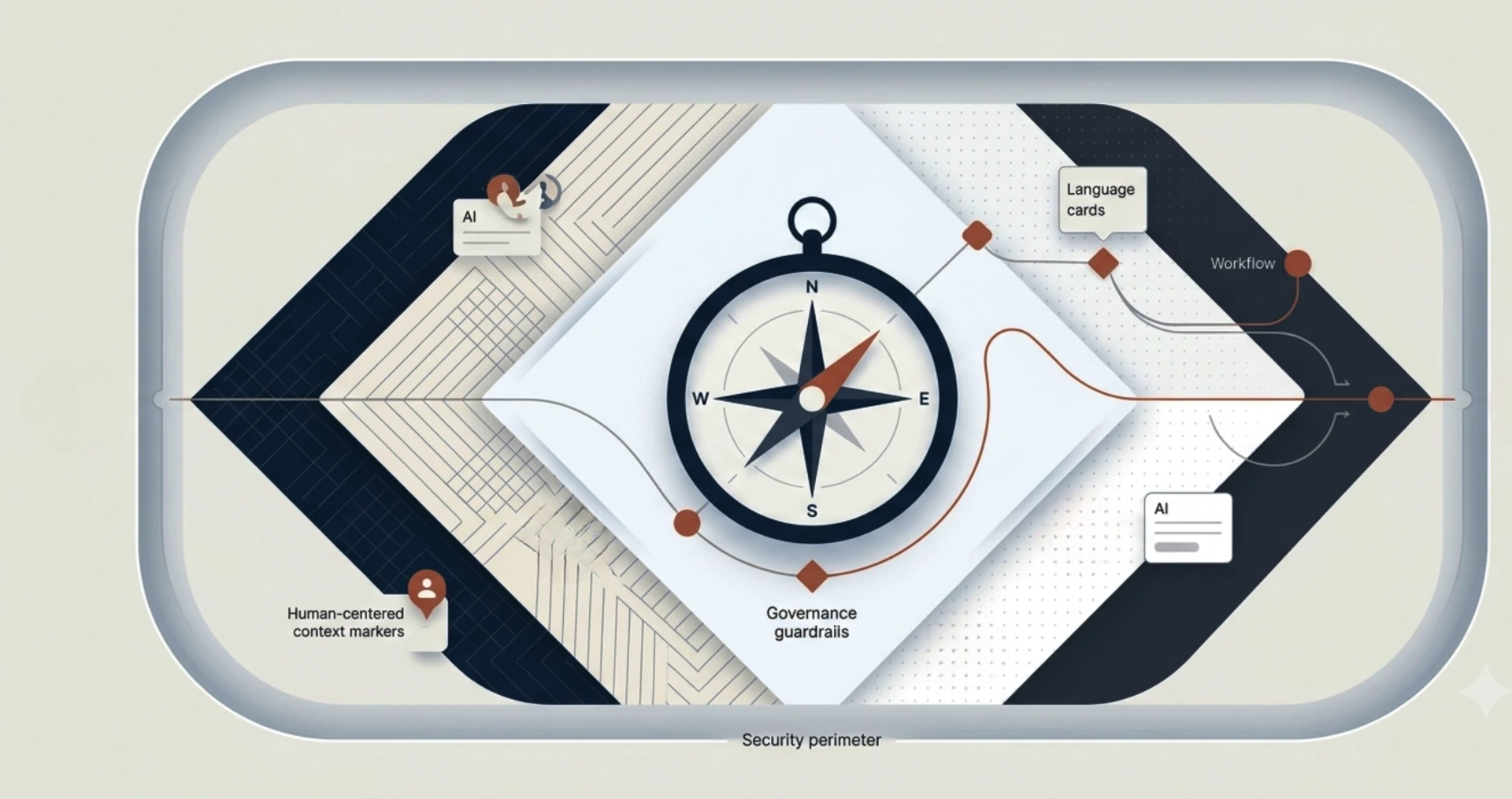
Once an AI agent starts acting inside a workflow, cultural blind spots become a governance issue. Governance means deciding what the agent is allowed to do, what it must never do alone, who reviews its output, when escalation is mandatory, and how errors get documented.
Recent work on AI agents already points in that direction. OWASP's Top 10 for Agentic Applications, published in December 2025, focuses on autonomous and agentic AI systems that plan, act and make decisions across complex workflows. It is a technical risk framework, not a cultural framework. But it is useful here because it shows why agentic systems must be treated differently from single-response chatbots.
The World Economic Forum's May 2026 playbook on AI agents, developed with Capgemini, also places governance at the level of delegated action. It introduces the Agent Capability and Authorization Profile as a deployment-level instrument covering delegation policy, system design and operational oversight, so delegated decisions and actions can remain auditable, enforceable and accountable across the lifecycle of deployment.
This matters because the problem is not always that the agent goes wrong technically. Sometimes it does exactly what it was allowed to do, but from a narrow understanding of the situation. It follows the prompt, uses the right permission, and still misses the human context: tone, urgency, politeness, hierarchy or local expectations.
So the question is not only: "Can the agent do this?" It is also: "Should the agent act here without a human checking the context?"
Governance note: the EU AI Act's Article 14 sets human oversight requirements for high-risk AI systems. It does not mean every AI agent is automatically covered, or covered in the same way. It does say high-risk AI systems must be designed for human oversight during use, with oversight measures proportionate to risk, autonomy and context of use.
As a small organization, you may not be running a complex enterprise agent, but the same logic applies the moment an AI tool drafts sensitive client emails, prepares candidate assessments, adapts training content, summarizes patient-facing information, or handles complaints before a human sees them.
The main risk is not that the agent "has an opinion." It is that the organization delegates interpretation without noticing it did.
Where do cultural blind spots appear in practice?
Scenario inspired by frequent situations. A consultant based in Togo uses an AI agent to draft client communications. Some messages go to clients in Europe, others to clients in the United States, and others to local West African clients. The consultant gives the agent one general instruction: "Write professional, friendly emails."
The agent applies a single dominant style to every message, usually the pattern most represented in its training data. It may produce a direct, low-context register common in some US business communication. For European clients, this can read as slightly too casual for a first contact. For local West African clients, it can skip over the relationship-building language that would normally open the exchange. No single email looks obviously wrong. The pattern only becomes visible when the consultant compares replies sent to different regions side by side.
Before agents, the consultant made this adjustment instinctively, message by message, drawing on lived experience of each professional culture. The agent does not do this on its own. It needs to be told, explicitly and per task, who the audience actually is.
Most cultural blind spots appear quietly. They show up as a slow drift in tone, priority or interpretation. One message feels slightly cold. One request is treated as less urgent. One profile looks less standard. The pattern becomes visible only when several cases are compared side by side.
In hiring, an agent may favor one dominant idea of professionalism: continuous career progression, familiar school names, standardized job titles, fluent corporate language. It can undervalue international experience, community-based work, a career interrupted by care work, or leadership described without the vocabulary of a large corporate environment.
Some signals can also become proxies. Years of experience may suggest age. Graduation dates may do the same. Postal codes may suggest socio-economic background. Gaps in employment may point to care responsibilities, illness, migration or other personal circumstances. If an agent treats these signals as neutral indicators of quality, exclusion can scale without being named directly.
In customer service, an agent may only escalate direct complaints. In some cultures and professional contexts, dissatisfaction is expressed indirectly, softened to preserve the relationship. The agent misses the urgency because it is looking for the wrong signal.
In translation, an agent may transfer meaning word by word but miss hierarchy, distance, respect, humor or historical sensitivity. That is not only a translation issue. It is a relationship issue.
In marketing, an agent optimizing for engagement is not necessarily optimizing for respect. A message can perform well on clicks and still flatten a minority experience into a generic hook.
In health, wellbeing or support contexts, the risk becomes more sensitive. An AI agent may summarize a person's request or prepare a response using language that sounds efficient but misses vulnerability, hesitation or shame. That does not mean the tool should never be used. It means human review becomes non-negotiable when communication touches distress, health, exclusion or personal vulnerability.
In education and training, an agent may recommend learning paths based on the vocabulary a learner uses. A confident learner using standard business language may appear more ready than a quieter learner with the same ability but a different cultural relationship to self-promotion. Again, the issue may not appear in one visible line. It appears in the accumulated pattern.
Why does cognitive diversity matter in AI governance?
This is where cognitive diversity becomes more than a value statement. It becomes part of the control system.
Cognitive diversity means involving people who do not all interpret situations the same way, whether that difference comes from language, geography, discipline, professional background, disability, age, lived experience, or direct exposure to the audience in question. It does not mean asking one person to represent a whole group. It means reducing the risk that one dominant view quietly becomes the default definition of "normal."
In practice, cognitive diversity matters at four moments.
Before choosing the use case: who could be affected if this agent gets context wrong? If the answer includes clients, candidates, learners, patients, vulnerable people, or people outside your usual cultural context, the workflow needs stronger review.
When writing examples: do the examples represent only one communication style? If every example assumes direct language, individual decision-making, formal credentials or one market's idea of professionalism, the agent may learn a narrow version of "good."
During testing: are edge cases and indirect language actually tested? A test set that only includes clean, standard, confident messages will not reveal how the agent handles ambiguity, hesitation, politeness, multilingual phrasing or culturally specific signals.
During review: can the reviewer recognize a cultural mismatch, or do they share the same blind spot as the system? A rushed approval from one person who shares the agent's assumptions is not meaningful oversight.
Quick check
If everyone reviewing the AI's output shares the same background, client exposure and professional vocabulary, your human oversight may be narrower than it looks.
That is why "human-in-the-loop" is not enough as a slogan. Which human? At what moment? With what authority? With what context? If the answer is vague, the control is weaker than it sounds.
For a professional beginning with AI, this does not require a large governance department. It starts with one habit: before allowing an agent to act, ask who could see the situation differently from you, and involve that perspective before the workflow scales.
How can teams detect cultural blind spots in 15 minutes?
Cultural context check for AI agents
Use this before letting an AI agent act inside a workflow. The goal is not to produce a perfect audit. The goal is to pause before automation and ask what the agent may misunderstand. A small team can complete it in under 15 minutes.
- What does the agent actually do?
Draft, rank, recommend, send, publish, escalate, update, decide? Name the action precisely. "It helps with support" is too vague. - Who can be affected?
Clients, candidates, learners, patients, employees, suppliers, readers. Include people who never see the AI interface but are affected by its output. - Which cultural assumptions are hidden in the task?
Tone, politeness, urgency, hierarchy, local vocabulary, professional codes, directness, self-promotion, conflict, trust, time, family, authority. - What could the agent miss?
Name one thing obvious to a human with local context but invisible to the system. Example: indirect dissatisfaction, careful politeness, local sensitivity, non-standard career signals. - Could any signal become a proxy?
Look for variables that seem neutral but may stand in for age, origin, socio-economic background, disability, care responsibilities or career interruption. - Who should review this?
Choose someone with relevant audience or field knowledge, not only someone with technical authority. - When must the agent stop?
Uncertainty, conflict, a vulnerable audience, sensitive data, legal or reputational risk, health-related content, financial impact, public communication. - How will mistakes get documented?
Record the missing context, not just the corrected sentence. The goal is to improve the workflow, not only polish one output. - Which permission should stay blocked for now?
If the workflow still feels unclear, keep the agent in draft mode. Let it suggest, summarize or flag, but not send, publish, reject or escalate alone.
This check will not replace a legal review, a DPO assessment, a technical risk review or a sector-specific compliance process. It helps a beginner ask better questions before the agent quietly becomes part of daily work.
One useful rule: if you would not give the same task, context and permissions to a new human assistant on their first day, do not give them to an AI agent without review. Intelligence is not the same as situated judgment.
Conclusion
The most difficult blind spots in AI agents are not only technical. They are cultural, organizational and human.
A better prompt improves a response. A stronger model reduces some errors. A clearer permission system limits some actions. None of these replaces a team's ability to notice what the system cannot see.
Before giving an agent autonomy, ask what it might misunderstand. Before scaling a workflow, ask who reviewed the cultural assumptions inside it. Before calling a process responsible, ask whether the people affected by it are represented in the review.
Culture is not a soft topic sitting outside governance. In AI agent workflows, culture shapes interpretation, escalation, communication and trust. That is part of how we decide what a system is allowed to interpret, prioritize and automate.
The agent can prepare. The human still has to arbitrate.
Further reading
Need guidance?
Ethical AI project - Let's clarify your needs, audiences and use cases.
Magazine - Read Le Doute Utile, the French Prompt & Pulse editorial magazine on responsible AI. The English version will follow in the next article.
Consultation - AI ethics review, use governance or AI Act compliance.
Book a meetingFAQ
What are cultural blind spots in AI agents?
Cultural blind spots are gaps between what an AI agent treats as normal and what is actually true for a specific audience, language, region, professional context or social situation.
Can better prompting remove cultural blind spots in AI agents?
It helps, but it cannot remove every blind spot. Prompts guide the system. They do not replace diverse testing, human review and clear escalation rules.
What is the difference between generative AI and an AI agent?
A generative AI model produces an output in response to a prompt. An AI agent uses models inside a workflow and may pursue a goal, use tools, update systems, route requests or trigger actions.
Why are AI agents more sensitive than simple chatbots?
An agent can act across a workflow, using tools, triggering actions and making multi-step decisions. A context error can travel further than a bad answer.
How can a small business reduce hidden bias in AI agents?
Keep the agent in draft mode at first, identify who is affected, define stop conditions, and review sensitive outputs with people who understand the audience.
What does cognitive diversity mean in AI governance?
It means involving people who do not all interpret situations the same way, so the team is less likely to mistake one dominant viewpoint for the whole reality.
Is culture really a governance issue?
Yes, when an AI agent acts inside a workflow. Culture affects interpretation, escalation, communication and trust. That is why it belongs in AI governance, not just communication.
Is this only relevant for large companies?
No. Any professional using AI to communicate, sort, summarize, recommend or act on behalf of a business can run into cultural blind spots.
Sources and references
- MIT Sloan School of Management, Dylan Walsh, "Generative AI isn't culturally neutral, research finds," 22 September 2025.
- Jackson G. Lu, Lesley Luyang Song and Lu Doris Zhang, "Cultural Tendencies in Generative AI," Nature Human Behaviour, 2025.
- Business Insider, Lee Chong Ming, "Making AI agents smart isn't the hard part, it's teaching them company culture, says a Goldman Sachs exec," 26 March 2025.
- World Economic Forum, "AI Agents in Action: A Playbook for Trusted Adoption, Authorization and Scaling," developed with Capgemini, May 2026.
- OWASP, "OWASP Top 10 for Agentic Applications for 2026," December 2025.
- European Union, Regulation (EU) 2024/1689, Article 14, human oversight for high-risk AI systems.
Transparency note: This article was co-written with the assistance of generative AI Claude AI and ChatGPT. The structure, analysis, editorial choices and final validation were carried out by the author. The author specializes in AI ethics, bias detection and responsible deployment for SMEs.